

On April 29, 2026, Broadcom’s Application Essentials product team hosted a live, public Office Hours session covering CA 2E, CA Plex, and CA Harvest SCM. The session was notable for its depth and specificity: Broadcom’s engineers and product managers walked through recent releases, answered technical questions from the community in real time, and shared a concrete multi-year roadmap for both CA 2E and CA Plex extending through 2029.
For the CA 2E and CA Plex community, this kind of direct engagement from the product team is genuinely valuable. These are platforms that underpin mission-critical IBM i applications at organizations around the world, and having a clear picture of their direction makes planning decisions significantly easier. What Broadcom shared was organized, substantive, and forward-looking.
Below is a summary of the key disclosures for CA 2E and CA Plex, along with context for what they mean for organizations running these environments. Broadcom also announced a quarterly cadence for these Office Hours sessions, with the next one scheduled for July 29, 2026.
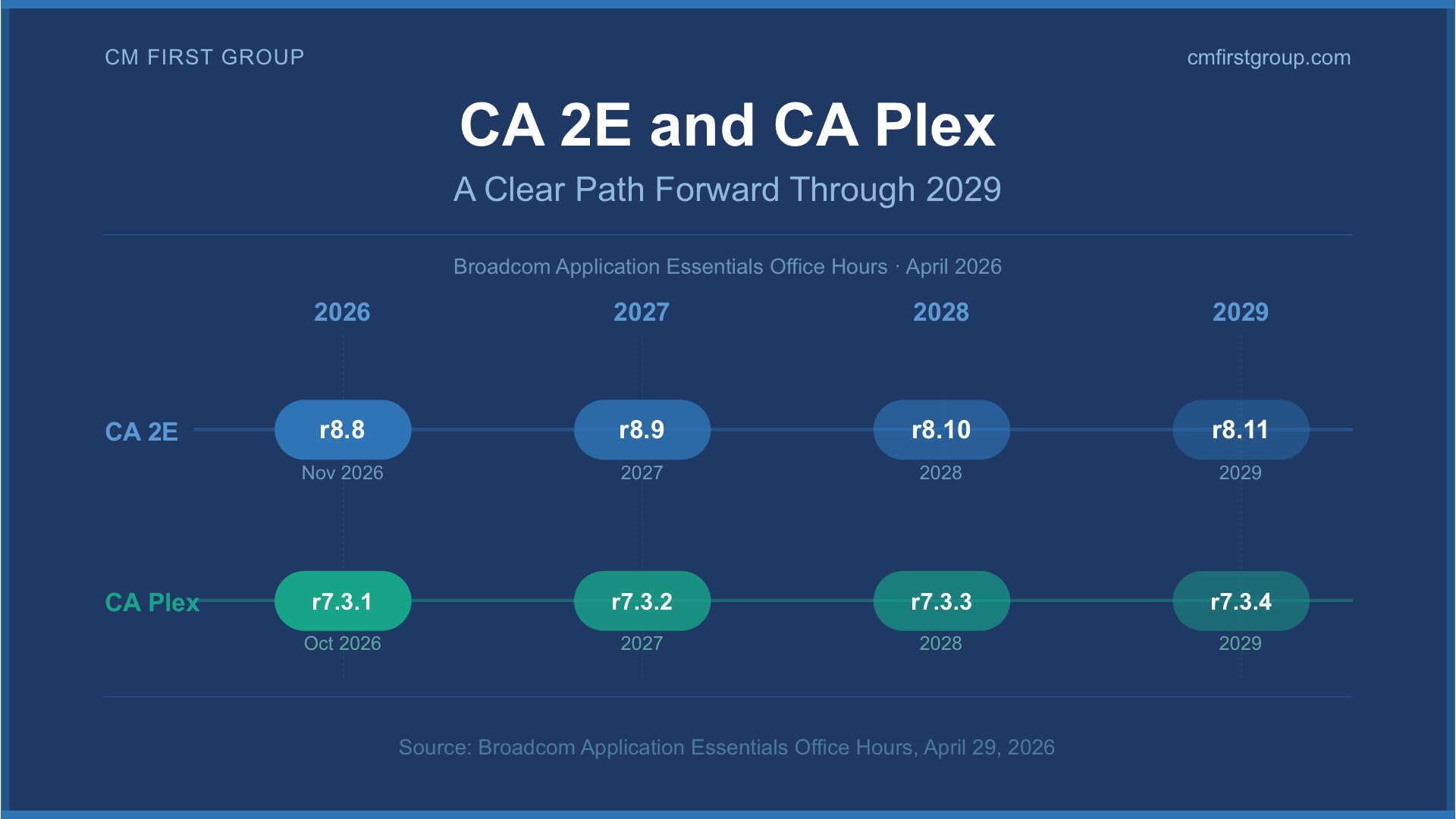
Broadcom shared a concrete multi-year roadmap for both CA 2E and CA Plex, giving organizations a clear planning horizon through 2029.
CA 2E: A Phased Roadmap Through r8.11
The CA 2E product team confirmed that CA 2E r8.8 is on track for general availability in November 2026, with a beta validation program now open for community participation. The currently active GA releases are r8.7 through r8.7.4, and the end-of-support timeline for the r8.7.x line will be formally announced after r8.8 ships. Organizations planning ahead should note this when evaluating upgrade timelines.
What Is Coming in r8.8 and Beyond
The r8.8 release leads with practical capability improvements: BLOB/CLOB data type support, the ability to move *NONE functions across files, database partitioning for large-scale legacy data models, and the introduction of a 2E Chatbot feature currently in early development. Broadcom has invited direct customer collaboration to shape the chatbot’s direction, reflecting an open and iterative approach to feature development.
The roadmap is organized into four releases spanning 2026 through 2029. Highlights include REST Web Service consumption in r8.9, expanded field lengths and new RPG IV built-in functions to ease COBOL-to-RPG migration, Single Sign-On support for the 2E Web Option in r8.10, and nested array support for Web Services in r8.11. Each release also carries platform certifications and technical currency improvements.
The PL/I-to-RPGLE Migration: Engineering Investment in the Core
One of the most significant disclosures in the session concerned PL/I. Broadcom confirmed that it has procured the PL/I compiler from IBM and that the PL/I runtime is fully supported. In parallel, the team is actively migrating CA 2E’s own internal PL/I code to RPGLE in a structured, release-by-release approach. This internal modernization spans the full architecture: the 2E Web Option in r8.8, the generators in r8.9, the Action Diagram and core functions in r8.10, and Screen Handling programs in r8.11.
For CA 2E customers, this phased migration is a meaningful indicator of engineering depth. Broadcom is not just maintaining the product’s surface — they are systematically modernizing the underlying architecture in a way that strengthens the platform’s long-term foundation. This is a sustained investment over multiple release cycles.
On the question of Power11 hardware, Broadcom confirmed that r8.7.4 certification on Power11 is in progress, with an announcement planned for the community when complete. The upcoming r8.8 release already includes Power11 hardware certification as part of its platform certification scope.
CA Plex: Usability, Modernization, and a Clear Path Forward
CA Plex r7.3.1 is targeted for general availability in October 2026, with a beta validation program also now open for participation. The currently active GA releases are CA Plex r7.2.1 (with cumulative patches 1 through 6) and r7.3.0. The roadmap extends to r7.3.4 and spans the same 2026 to 2029 window as the CA 2E plan.
Upcoming Features and Technical Currency
The r7.3.1 release introduces several improvements with immediate practical value: improved search capability in the Action Diagram, Git support for generated code and group models, report creation in PDF format replacing RTF output, and the introduction of a Plex Chatbot in early development. On the technical currency side, the migration of the C++ ActiveX offering from VBScript to Python addresses a long-standing modernization need in a meaningful way.
Looking ahead, the roadmap through 2029 includes model management automation for update and extract operations, improved performance through better client-server visibility, an enhanced impact analyzer, JSON format support for WCF Services, and an OpenJDK 8-to-latest-LTS upgrade. Platform certifications and security fixes run continuously throughout.
In the Q&A, Broadcom was candid and constructive about requirements currently in the backlog, including Unicode support, SSH encryption, additional data types, native SQLRPG functions, and IBM i MFA support. These were acknowledged openly as areas being considered for future releases, and the product team expressed genuine interest in community input to help shape prioritization.
What This Means for CA 2E and CA Plex Organizations
The April 29 session, and the quarterly Office Hours cadence it introduces, gives CA 2E and CA Plex organizations something directly useful: a structured, ongoing channel for product visibility and community input. The detail and transparency of what Broadcom shared makes it easier to align internal upgrade and modernization planning with a clear picture of where the platforms are headed.
For organizations with active modernization initiatives, the roadmap also clarifies the environment in which those initiatives are operating. Whether a team is planning to stay on CA 2E or CA Plex, pursue a modernization path alongside the platforms, or some combination, having a credible view of the product direction improves the quality of those decisions.
That planning work typically begins with a thorough understanding of what is currently in the environment. Most CA 2E and CA Plex application portfolios have grown over many years, and the full picture of business logic, program dependencies, and transformation scope is often more complex than expected. CM evolveIT supports that discovery work directly, using compiler-level static analysis across CA 2E, CA Plex, COBOL, RPG, and related IBM i technologies to give organizations a precise foundation for whatever path they choose.
Interested in understanding your CA 2E or CA Plex environment before your next planning cycle? Contact CM First Group at info@cmfirstgroup.com or 888-866-6179 to learn how CM evolveIT supports legacy discovery and transformation planning.
